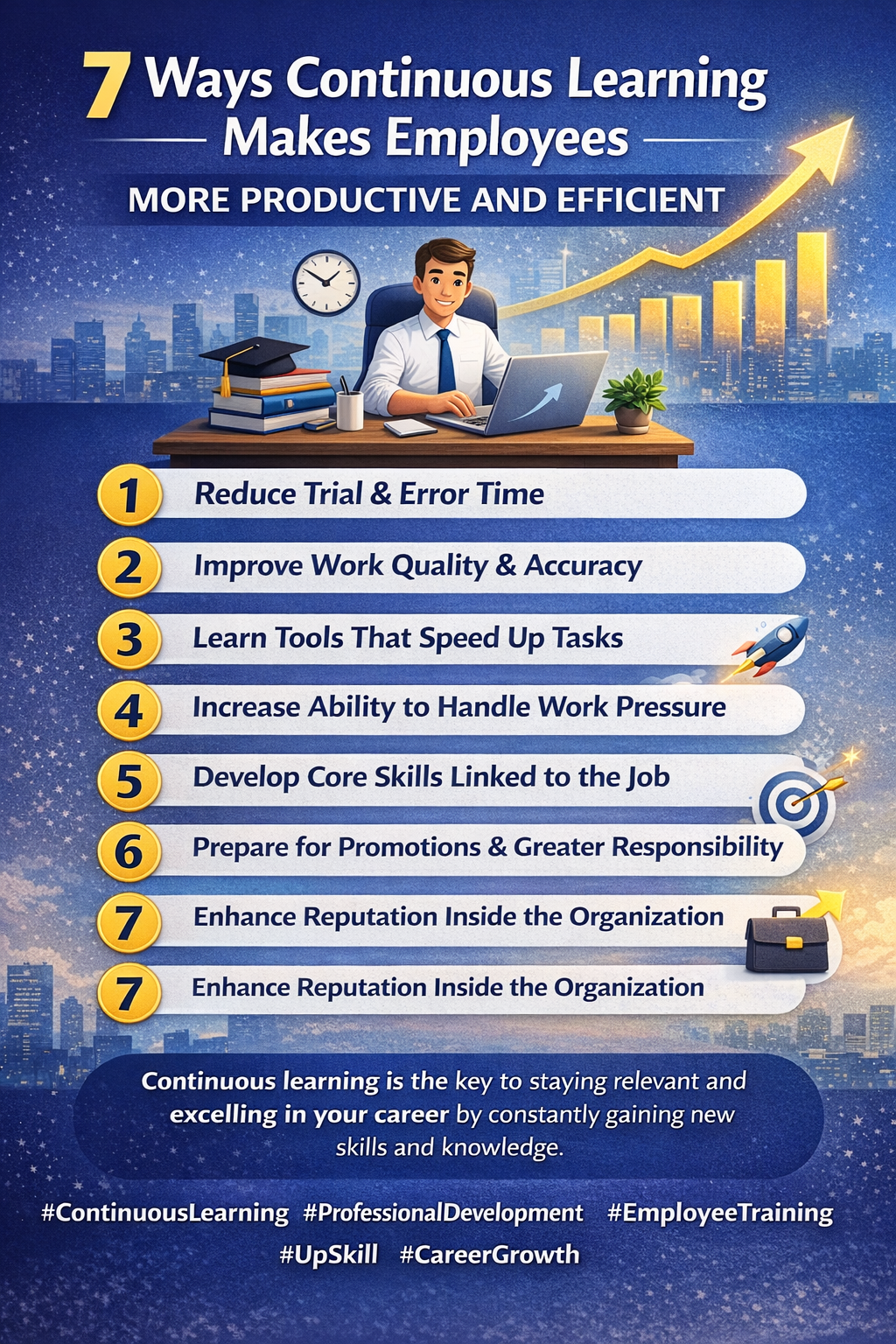
7 Ways Continuous Learning Makes Employees More Productive and Efficient
The job market is no longer as stable as it once was. Tools change, systems evolve, new roles emerge, and others disappear. In this fast-moving reality, continuous learning has become one of the most important factors behind an employee’s success, stability, and professional growth. It is not simply “extra courses”; it is a work mindset that directly improves productivity, efficiency, problem-solving ability, and gives employees a clear competitive advantage inside and outside the organization.
First: How does continuous learning increase employee productivity?
Productivity does not mean working longer hours. It means achieving more output with higher quality in less time. The impact of continuous learning appears in several ways:
1) Reducing time wasted on trial and error
An employee who learns their tools well and develops their skills can avoid many unnecessary attempts and reach the right solution faster from the start.
2) Improving work quality and reducing mistakes
The more an employee understands tasks, standards, and tools, the fewer errors occur—errors that often cause rework, delays, or complaints. As a result, quality rises and trust increases.
3) Gaining tools that speed up execution
Continuous learning opens the door to mastering tools that improve performance, such as:
-
Time and task management tools
-
Automating repetitive tasks
-
Data analysis and decision-making skills
-
Using modern technologies for communication and project management
4) Increasing the ability to handle work pressure
Learning does not only build skill; it also builds adaptability. A learning-oriented employee can adjust to changing priorities, handle new challenges without confusion, reduce stress, and stay effective.
Second: How does continuous learning improve job performance and efficiency?
Job efficiency means that an employee has the skills, knowledge, and behaviors needed to perform consistently and effectively. Continuous learning strengthens that efficiency through:
1) Developing core professional skills
Such as planning, organization, communication, presenting, report writing, problem analysis, and decision-making.
2) Improving professional thinking and expanding experience
An employee who keeps learning develops a “bigger picture” understanding of work:
they understand why decisions are made, how their role connects to department and company goals, and how their work affects the customer and overall results.
3) Preparing for promotions and greater responsibilities
Promotion is not only based on current performance, but also on the ability to take on higher-level tasks. Continuous learning prepares employees for leadership, team management, and more complex challenges.
4) Strengthening an employee’s reputation inside the organization
A learning-focused employee is often seen as:
-
Reliable
-
Fast to learn
-
Capable of offering solutions and improvements
This reputation opens doors to important projects and better internal opportunities.
Third: Why do some employees stop learning?
Common reasons include:
-
Lack of time and heavy workload
-
No clear plan
-
The belief that learning requires long programs
-
Fear of starting or fear of failure
-
Not linking learning to a clear career goal
The solution is not taking more courses, but turning learning into a simple, continuous system.
Fourth: How can an employee keep learning throughout their career? (A practical, doable plan)
Here is a realistic approach that makes learning part of professional life without stress:
1) Set a clear career goal every 3 months
Instead of “I want to improve,” choose a specific goal, such as:
-
Improving presentation skills
-
Mastering Excel / Power BI
-
Learning project management
-
Improving professional English
-
Developing negotiation skills or professional email writing
2) Learn daily—even for just 20 minutes
Continuous learning is not about big jumps, but about consistency.
20 minutes per day = more than 120 hours per year, enough to build a strong skill.
3) Follow the rule: Learn – Apply – Share
-
Learn: a short lesson, article, or video
-
Apply: use the idea immediately in your work
-
Share: share what you learned with colleagues or write a short summary for yourself
This approach turns knowledge into real skill.
4) Learn from the job itself (not only from courses)
Some of the strongest learning comes from:
-
Working on a new project
-
Taking on tasks outside your usual scope
-
Shadowing an experienced colleague
-
Asking your manager for feedback
-
Analyzing mistakes and turning them into lessons
5) Build a “skills library” that fits your job
Divide skills into:
-
Technical/specialized skills (based on your field)
-
Core skills (communication, time management, leadership)
-
Digital skills (tools, reporting, analytics)
Then choose one skill each period and train deeply.
6) Use simple tracking tools
For example:
-
A weekly list of what you learned
-
An “Errors & Lessons” notebook
-
A skills table you want to improve
-
A monthly self-review: What improved? What still needs work?
7) Ask for a learning path at your workplace—or create your own
If your company offers internal training, use it. If not, you can build your own path through:
-
Short courses
-
Books and articles
-
On-the-job practice
-
Small side projects
Fifth: Examples of skills that quickly improve productivity (in most jobs)
If you want skills with a fast and clear impact on performance, these are some of the best options:
-
Time management and prioritization
-
Using Excel / Google Sheets efficiently
-
Professional email and report writing
-
Project management basics (planning, tasks, follow-up)
-
Communication and conflict resolution
-
Presentation and persuasion skills
-
Data analysis basics and decision-making
Conclusion
Continuous learning is a direct investment in your productivity, efficiency, and career growth.
An employee who keeps learning does not only become faster at completing tasks—they become smarter in choosing solutions, stronger in facing change, and more ready for future opportunities.
بحث
أحدث المقالات

Professional development for teachers from rote instruction
Teacher professional development
2026-Feb-09
7 Ways Continuous Learning Makes Employees More Productive a
The job market is no longer as stable as it once was. Too
2026-Feb-08


Are family businesses a good option for job seekers?
Family businesses are those owned and run
2025-Dec-19